Read the motion.
A BMI160 accelerometer and gyroscope capture movement on a wrist-worn ESP32 platform.
Six axes. One wearable.I’m Tri. I build embedded systems that sense,
think, and act beyond the screen.
Turn the dial. Change the signal.
That instinct to experiment?
It’s how I approach engineering.
A playful signal study.
Not measured sensor data.
A small device.
A critical connection.Edge-AI fall detection with a LoRa alert link.
A BMI160 accelerometer and gyroscope capture movement on a wrist-worn ESP32 platform.
Six axes. One wearable.A TinyML model classifies falls on-device. A warning and cancellation window let the wearer respond before an alert is sent.
Shown: iteration 3 · 90.3% validation accuracyThe wearable sends an alert to a paired LoRa receiver. No cellular connection, Wi-Fi, or cloud service required.
Local intelligence. Long-range radio.Select a stage to explore the system
Classification accuracy
On-device inference
Peak RAM usage
Labeled motion samples
Prototype figures reported in my résumé; collected fall/non-fall dataset. Not a clinical validation.
Automated a photovoltaic testbed with Arduino control, relay-switched power stages, and closed-loop temperature control. Python-driven illumination sweeps logged data at 20 samples per minute.
Integrated DS18B20 sensors, a thermoelectric module, and a programmable power supply. Designed and 3D printed mounting brackets in Fusion 360 to secure the hardware.
Built Python and MATLAB workflows for Monte Carlo simulations of electron-hole creation in GaAs. Processed over a million rows and reduced analysis time by 85%.
Simulated 13 energy levels from 5 to 65 keV. Built repeatable visualizations and benchmarked simulation output against published GaAs radiation-response data.
Select a project.
Get a little closer to the engineering.
Illustrative power paths, not a protection or transfer simulation.
Industrial power distribution & EPC design: from the single-line diagram to cable routing and UPS backup.
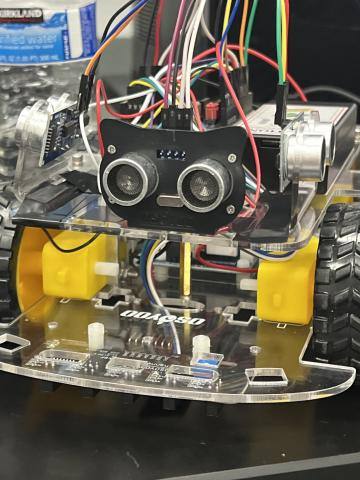
Actual project photography / Obstacle avoidance & line following
Three ultrasonic sensors and a line sensor help an Arduino Uno robot navigate its environment.
Concept demonstration: 40% threshold. Not a measured project setting.
Capacitive moisture sensing and a relay-driven pump close the loop between a plant’s needs and its water supply.
I’m Tri Phan, an electrical engineering student at Illinois Institute of Technology.
I work across embedded systems, semiconductor research, and power design. I enjoy turning an uncertain idea into something I can wire up, program, measure, and improve.
B.S. Electrical Engineering
Expected December 2027
ESP32 · Arduino · LoRa
PCB design · Soldering
Altium · Fusion 360 · 3D printing
C++ · Python · MATLAB
TinyML · Edge Impulse
Java · SQL · Git · Linux
Oscilloscope · Multimeter
Sensor data acquisition
SPICE · Power & cable sizing